
Whether you just found lien on a home you want to buy, discovered one on your own property, or want to know how to negotiate a lien on a house , this guide covers all of it.
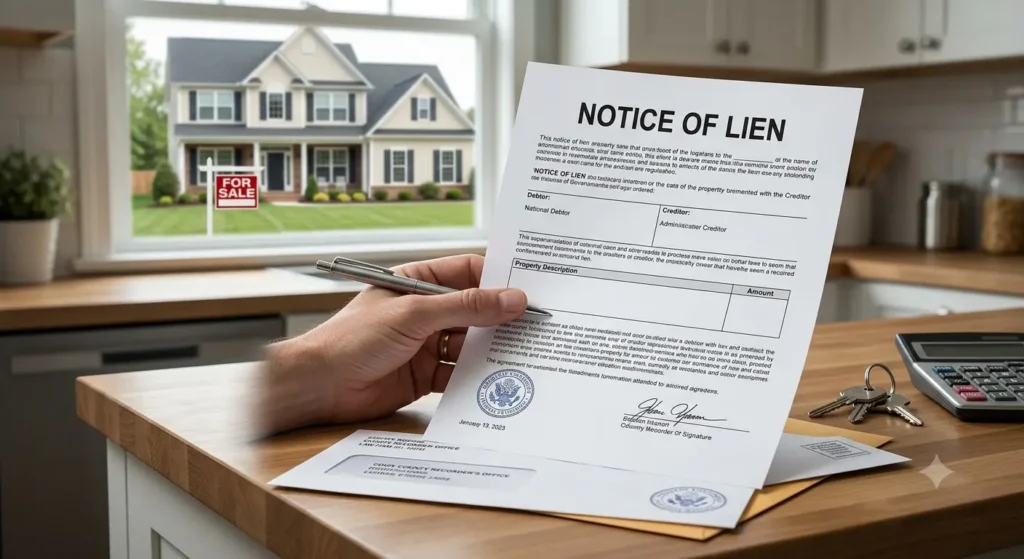
A lien on a house is a legal claim attached to the property, usually because of an unpaid debt. Think of it as a “pay me first” notice that sticks to the home itself — not just the person who owes the money. If the house is sold, the debt does not disappear. It follows the property.
Key facts about a lien on a house:
Not every lien is a problem. There are two main types:
Voluntary liens — the homeowner agreed to them. A mortgage is the most common example. When you take out a home loan, you give the lender a legal claim on your property until the debt is paid off. Home equity loans and HELOCs work the same way.
Involuntary liens — placed without the owner’s consent, usually because of unpaid debts. These are the ones that cause problems.
| Lien Type | Voluntary or Involuntary | Common Cause | Blocks Sale? |
| Mortgage | Voluntary | Home loan | Yes — paid off at closing |
| Tax Lien | Involuntary | Unpaid property or income taxes | Yes |
| Mechanic’s Lien | Involuntary | Unpaid contractor work | Yes |
| Judgment Lien | Involuntary | Court-ordered debt | Yes |
| HOA Lien | Involuntary | Unpaid association dues | Yes |
This depends entirely on the type of lien.
A mortgage lien is completely normal. Almost every homeowner has one. It does not hurt your credit, does not block your daily use of the home, and goes away the moment you pay off the loan. There is nothing alarming about a mortgage lien.
Involuntary liens are a different story. A tax lien, judgment lien, or mechanic’s lien on a house can:
The most important thing to understand: a lien does not prevent you from living in your home. You can stay, make payments, and go about your life. What a lien does is lock the property — you cannot sell it, refinance it, or pull equity out of it until the lien is resolved.
Yes — and this happens more often than people expect. Involuntary liens can be filed by contractors, the IRS, courts, or local governments without direct notice to the homeowner. Bills can go to an old address. A contractor you paid might have failed to pay their subcontractor, who then files a lien against your property.
This is one of the strongest reasons to purchase owner’s title insurance when buying a home, and to do a periodic title check on a property you already own.
The most common lien on any house. When a buyer takes out a loan, the lender records a lien as collateral. At closing, the seller’s mortgage gets paid off from the sale proceeds before any money goes to the seller.
Tax liens carry the highest priority of any lien. If a homeowner fails to pay property taxes or federal income taxes, the government files a lien that jumps ahead of nearly everything — including the mortgage. Unpaid tax liens will stop any sale immediately.
The IRS also has formal programs for resolving federal tax liens, including the Offer in Compromise and installment agreements — more on those in the negotiation section below.
If a contractor, subcontractor, or supplier does work on a home and doesn’t get paid, they can file a mechanic’s lien. These are especially common in renovation situations and can be filed even if you paid your general contractor — if they failed to pay their subs, those subs can file against your property.
When someone wins a lawsuit against a homeowner and the debt goes unpaid, the winning party can file a judgment lien against the property. These can linger for years — up to 10 in many states — and must be paid or released before the title can transfer cleanly.
Homeowners associations can file a lien for unpaid dues, fines, or assessments. In some states, HOA liens carry “super priority” status, meaning a portion of the lien can rank ahead of even the first mortgage. Even small HOA liens can derail a closing if left unresolved.
When you buy a home, a title company or real estate attorney runs a title search — a review of public records going back decades. This search pulls up every lien ever filed against the property, including:
If a lien is found, the title company includes it in the title report and flags it for both buyer and seller. From that point, the sale typically goes on hold until the lien is resolved.
Who handles it:
This is one of the most important questions buyers ask — and it deserves a direct answer.
In most cases, you cannot close on a house with an unresolved lien. Mortgage lenders will not fund a purchase until the title is clear. If you are a cash buyer, you technically could proceed — but you would be taking on serious risk.
Here is what actually happens at each stage:
If the lien is found before closing: The sale pauses. The seller is expected to resolve it — either by paying it off, negotiating a settlement, or using the sale proceeds to satisfy the debt at closing. Most contracts give the seller a specific number of days to clear any title issues.
If you close with an undiscovered lien: The lien transfers with the property. You become responsible for someone else’s debt. The lienholder can pursue you, and in serious cases, can foreclose — even if your mortgage payments are current. This is rare when a proper title search is done, but it can happen.
What about equity shortfall? This occurs when the total of all liens plus the remaining mortgage exceeds the home’s sale price. For example: a home sells for $280,000, but the seller owes $200,000 on the mortgage and has a $100,000 lien. That’s $300,000 in claims against $280,000 in proceeds — a $20,000 shortfall. In this case, a short sale may be the only option.
Cash buyers vs. financed buyers: Cash buyers can technically close on a home with a lien, but almost never should. Financed buyers have no choice — the lender will require a clean title before funding. In both cases, owner’s title insurance is the essential protection.
Negotiating a lien is possible — and often successful — especially for involuntary liens like mechanic’s liens and judgment liens. Lienholders frequently prefer a partial payment now over a long, uncertain foreclosure process.
Here is how to approach it step by step:
Step 1: Get the lien details from public records
Obtain a copy of the lien from the county recorder’s office. Confirm the amount owed, the filing date, who filed it, and their contact information. You cannot negotiate what you haven’t verified.
Step 2: Verify the lien is valid
Check that the lien was filed correctly under your state’s rules. Some liens have procedural requirements — filing deadlines, proper notice periods — that if missed, make the lien invalid or unenforceable. A real estate attorney can help identify these vulnerabilities.
Step 3: Understand your leverage
Lienholders know that foreclosure is expensive, slow, and not guaranteed to recover their money. That gives you negotiating room. The closer you are to a sale closing, the more motivated they often are to settle — getting partial payment now beats waiting years.
Step 4: Make a written opening offer
For mechanic’s liens and judgment liens, starting at 40–60% of the balance is reasonable. For smaller liens, creditors often accept even less. Never make a verbal offer — everything should be in writing from the start.
Step 5: Negotiate by lien type
Step 6: Get the settlement agreement in writing before paying anything
The written agreement should include the exact settlement amount, payment terms, and a commitment to file a lien release upon payment. Do not wire money without this document.
Step 7: Confirm the lien release is recorded
After payment, the lienholder must file a release of lien with the county recorder’s office. Follow up to confirm it has been recorded. Ask for a copy for your records. A verbal confirmation means nothing — only the recorded release matters.
When to hire an attorney: For IRS liens, judgment liens over $10,000, disputed mechanic’s liens, or any situation where the lienholder is unresponsive, an experienced real estate attorney is worth every dollar.
If a house is sold or foreclosed, lienholders do not all get paid equally. Priority determines the order — and lower-priority lienholders may get nothing if the sale proceeds run out.
The general rule is “first in time, first in right” — the earliest recorded lien has the highest priority. But there are important exceptions:
| Lien Type | Typical Priority Order |
| Property Tax Lien | First — always ahead of everything else |
| Super-Priority HOA Lien | First in some states, for a limited amount |
| First Mortgage | Behind tax liens; ahead of most others |
| Mechanic’s Lien | Varies — can be high if work started early |
| Judgment Lien | Lower; ranked by date filed |
| Second Mortgage / HELOC | Near last |
Why this matters for buyers: If you purchase a home and miss a high-priority lien — particularly a tax lien — the government can foreclose even if you are current on your mortgage payments. This is exactly why a thorough title search and owner’s title insurance are non-negotiable.
When a lien appears during the title search, you have several paths forward:
1. Seller pays the lien before closing
The most common outcome. The seller uses their own funds or a portion of the sale proceeds to satisfy the debt. The lienholder files a release, and the closing proceeds on schedule.
2. Lien paid at closing from proceeds
The title company holds the lien payoff amount in escrow and distributes it directly to the lienholder at closing. This is clean and common for mortgage payoffs and smaller liens.
3. Seller negotiates a settlement
The seller works with the lienholder to accept less than the full amount. Once agreed and paid, the lien is released. This can take time — build it into your closing timeline.
4. Escrow holdback
In rare cases, both buyer and seller agree to hold back funds in escrow after closing to pay the lien. This requires the lienholder’s cooperation and is not always possible.
5. Buyer accepts the lien with a price reduction
Occasionally, a buyer will agree to take on a small, manageable lien in exchange for a reduced purchase price. This only makes sense for minor liens with clear resolution paths — and requires owner’s title insurance.
6. Walk away
If the seller cannot or will not resolve the lien, most purchase contracts allow the buyer to exit and recover their earnest money. A lien that cannot be resolved is a legitimate reason to cancel a deal.
| Option | Best Used When | Risk Level |
| Seller pays lien | Seller has equity to cover it | Low |
| Paid from proceeds at closing | Lien is small relative to sale price | Low |
| Seller negotiates settlement | Involuntary lien, seller has leverage | Medium |
| Escrow holdback | All parties agree, lien is time-limited | Medium |
| Buyer accepts lien | Minor lien, significant price reduction | High — use with caution |
| Walk away | Lien unresolvable or seller uncooperative | None |
Even the most thorough title search can miss something. Old tax debts, clerical errors, fraudulent filings, or liens from previous owners can hide in public records. Title insurance is the safety net.
There are two types:
Owner’s title insurance is a one-time cost paid at closing. If a lien surfaces after you buy — one the title search missed — your policy covers legal defense costs, settles valid claims, and compensates you for financial loss up to your coverage amount.
What title insurance does not cover:
In most cases, no — not without resolving the lien first. Mortgage lenders require a clear title before funding. Cash buyers technically can proceed, but take on significant legal and financial risk. The lien must be paid, settled, or released before most sales can close.
The seller is responsible for clearing liens before closing. In practice, the title company often pays lienholders directly from the sale proceeds. If a lien is missed and the sale closes, the new owner can become responsible — which is why title insurance exists.
It depends on the type and state. Judgment liens typically last 5–10 years and can be renewed. Tax liens stay until paid. Mechanic’s liens have shorter windows — often 1–2 years — but can be enforced before expiration. A lien does not simply disappear; it must be formally released.
Sometimes. If a lien was filed incorrectly, past its statute of limitations, or fraudulently, a court can order its removal. In some states, a mechanic’s lien can be replaced with a surety bond, freeing the property while the dispute continues. An attorney can assess whether a lien is challengeable.
The debt grows — interest and penalties accumulate. The lienholder’s options increase over time, including pursuing foreclosure. Tax liens are particularly aggressive: the government can seize and sell the property if taxes remain unpaid long enough. Ignoring a lien never makes it go away.
It depends. A mortgage lien has no negative impact on its own. Involuntary liens — particularly tax liens and judgment liens — often reflect underlying unpaid debts that do affect credit. In general, if a creditor had to file a lien to collect, the underlying delinquency has likely already impacted your credit.
Most purchase contracts include a clear title requirement, which effectively obligates the seller to resolve any liens before closing. If they cannot, the buyer typically has the right to cancel and recover their earnest money. Sellers cannot transfer clear title without resolving liens.
A lien on a house is not always a dealbreaker — but it always requires attention. Whether you are buying a home and a lien surfaces during the title search, or you are a homeowner who just discovered a claim against your property, the steps are the same: identify the lien, understand its type and priority, and move quickly to resolve it.
For buyers, insist on a full title search, require the seller to clear any liens before closing, and invest in owner’s title insurance. For homeowners dealing with an involuntary lien, act early — the longer a lien sits, the more it costs.
Veterans Abstract specializes in title searches, lien resolution, and settlement services across Pennsylvania. If you have questions about a lien on a property you are buying or already own, contact our team — we have seen every type of lien situation and can help you navigate it cleanly.